

Inside the Human Brain
The Hearing the Invisible Proof of Concept Installation was held Feb 13-15, 2025 at the Tornabene Theater on the University of Arizona College of Fine Arts Campus.
While the scenic design was compacted and simplified for a proof of concept, the piece featured all functionalities that future installments will have, including:
- A companion AR app to allow attendees to listen to EEG waveforms turned into music
- 19 floating EEG nodes to show attendees live human EEG data using LEDs
- Interactive tables to educate attendees about waveforms and cognitive disorders
Below you will find event photos and production details.
EVENT PHOTOS

Dr. Tally Largent-Milnes leaning over an interactive activity talking with two children
Photo Credit: KLH
EEG Lead and Medical Student Matthew Flowers speaks to a group in the middle of the exhibition
Chris Zatarain
Professor Cynthia Stokes speaking to a crowd at the exhibition
Chris Zatarain
A group of attendees gather around a display of the augmented reality app.
Photo Credit: KLH
A close-up of an attendee holding up their phone running the augmented reality application for the event displaying EEG nodes and audio playback.
Photo Credit: KLH
An attendee to the exhibition reflects on their experience in the lobby
Chris ZatarainPRODUCTION DETAILS
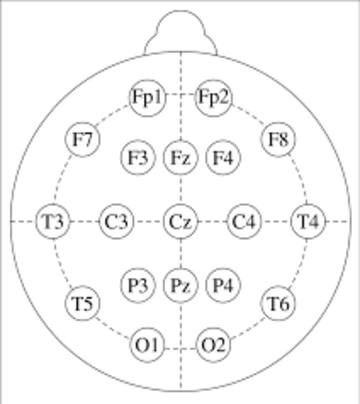
19 nodes are labeled on a circular rendering of a scalp indicating the node positions on a standard 20-electrode EEG recording cap
DESIGN INSPIRATION
The HTI team envisions an experience that takes as its number one inspiration the invisible forces and physiological processes that make up the human brain. The primary challenge to this, of course, is in depicting invisible forces and microscopic physiological processes in a physical manner. Scientists have many high-level tools at their disposal, but it takes unique methodologies to abstract these concepts into a domain that can be experienced by anyone. To learn more about the methodologies we developed in the course of bring HTI to life, please visit the page Documentation & Resources.
Presenting biomedical information in an immersive format requires balancing ground-truth biofeedback with comprehensibility. Simplifying the myriad cortical structures of the brain, medulla, pons down to 19 cortical nodes (see figure on right) plus a "brain stem" was a necessary compromise to develop a proof of concept. The design team iterated over proposals that included facial information, thalamic information, but they all hindered the ability for people to walk around the brain and interact with nodes. Deeper information about the regions of the brain people stood in needed to be opt-in, and not clutter the exhibit floor or the nodes themselves, so we migrated scientific information about cortical regions into a thorough physical map that attendees could interact with. Active research is on exploring a modular system with variable height, depth, and detail to accommodate a variety of exhibit halls, and on improvements to fabric and visual design.
IT TAKES A VILLAGE
Dr. Tally Largent-Milnes (School of Medicine -- Pharmacology) led the installation's communication of medical and neurological information alongside her student Matthew Flowers, who also coordinated the poster presentation and art featured in the lobby. Professor Cynthia Stokes (School of Music) directed the installation, assembled the creative team, and led its promotion and funding as the other PI alongside Dr. Largent-Milnes. Michael Vince (DMA graduate of 2025 and now DCC Staff School of Music) developed not only the audio and compositions featured in the project but also single-handedly created the Augmented Reality application. Brian McElroy (DCC Staff School of Music) coordinated external contractors and student interns, managed project finances and schedules, and designed lighting and projection. Expert project designers included scenic designer Lexy Scott and LED designer Kempton Hall. Invaluable undergraduate interns included Ruth Clarke, Addie Kinney, Angelina Quinet, Stephanie Schoone, and Emily Stone. Vocal performers included Marcus Hawkins, Beth Jargstorf, Aysen Milliogullari, Jared Peterson, and Alison Wahl.
The team thanks the below groups and individuals for their support:
Research Leadership Institute | Kim Patton
College of Fine Arts Integrative Arts Research | Associate Dean Ellen McMahon, Audrey Molloy
Arizona Health Science Center and Comprehensive Center for Pain and Addiction | Stacy Pigott, Stefanie Mitchell, Kris Hanning (photography)
School of Theater, Film and TV | Nadia Eldurubi, Professor Matt Marcus
School of Music Production Team | Carson Scott, Reid Ferris and Rick Chavez
We would also like to thank the following College of Fine Arts and College of Medicine contractors and volunteers who contributed:
CFA | Chris Zatarain (videographer), Professor Ilayda Aluntas Nott (project assessment)
CoM-T | Medical students Nora Griffith and Thomas Brower
FINAL NOTES
The Feb 2025 Proof of Concept event would not have been possible without the support of grants and organizations including the Research Leadership Institute, the Confluence Center for Creative Inquiry, and more.